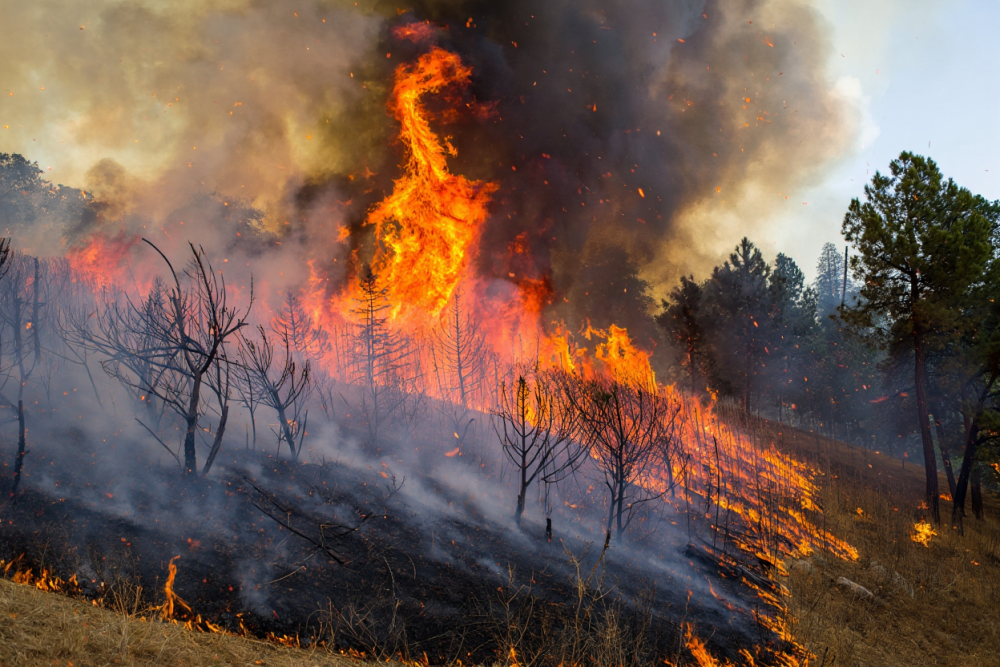
While Georgia is well known for its peaches, when January comes around, it becomes famous for something else: wildfires. Georgia wildfires, according to the Georgia Forestry Commission, the Empire State of the South averages more than 2,300 wildfires per year, with each wildfire burning an average of 7 acres (2.8 ha).
But, if you’re thinking the wildfire season in Georgia is neatly enclosed within the summer months, you’re wrong. In the Peach State, wildfire peaks in spring.
The Primary Wildfire Season in Georgia
According to the Georgia Forestry Commission, the Empire State of the South typically sees its most active wildfire season from January to April. While many might associate spring with the rain, in Georgia, spring months are typically dry and windy. This is the first ingredient for the Peach State’s wildfires. These dry cold fronts and gusty winds can fan a small spark into a fast-moving fire in minutes.
Now, how these sparks start can be attributed to bare trees. Without new leaves, trees barely shade or cool the forest floor, so sunlight has direct access to the ground at this time. It quickly dries out dead leaves, pine needles, and other organic matter lying on the ground. And, this concentrated sunlight can ignite vegetative fuels and light up a spark.
However, in Georgia, people cause more wildfires than this natural process. The no. 1 culprit: debris burning. In spring, many residents clear their yards and burn dried leaves, but because of the windy atmosphere, these leaves can escape, land on abundant vegetative fuel, and start a new, uncontrolled fire elsewhere.
Wildfire season comes to a close when May arrives. At this time, trees have typically grown new leaves, and with their green garb complete, the cool, shaded environment puts a brake on fire activity.
Causes of Wildfires in Georgia
As already mentioned, the no. 1 cause of fire in the Empire State of the South is debris burning. “More than half [over 50%] of the wildfires in Georgia start because of careless debris burning,” the Georgia Forestry Commission states in its website.
According to the commission, debris burning can be categorized into different types, as follows:
- Yard leaf piles (the most common cause of wildfires),
- Agricultural,
- Forestry site preparation,
- Construction land clearing, and
- Escaped prescribed burning.
Campfires and ignition by hot equipment can also spark a fire. Plus, other factors, including warm temperatures, low humidity, wind, atmospheric instability, can exacerbate the risk of wildfires.
Georgia Laws About Burning Debris
In the Peach State, open burning is prohibited, especially when it comes to burning of man-made materials, such as tires, shingles, plastics, lumber, or household garbage, even in a burn barrel. Open burning is defined by the Georgia Rules for Air Quality (391-3-1-.01(tt)) as “any outdoor fire from which the products of combustion are emitted directly into the open air without passing through a stack, chimney, or duct.”
However, there are exceptions—13 types of burn activities to be precise. The Environmental Protection Division (EPD) lists these legal burn types as follows:
(1) Reduction of leaf piles, yard debris, or hand-piled natural vegetation on premises,
(2) Agricultural procedures for production or harvesting of crops (if land tract is 5 acres or less),
(3) Burning vegetative material for agricultural operations (if land tract is greater than 5 acres),
(4) Prescribed burning,
(5) Recreational purposes and cooking,
(6) Fire-fighting training,
(7) Acquired structure burns,
(8) Vegetative debris from storms,
(9) Weed abatement, disease, and pest prevention,
(10) Open flame devices,
(11) Land clearing, construction, and right-of-way maintenance,
(12) Disposal of packaging materials for explosives, and
(13) Land clearing with an air curtain destructor.
Burn activities 1, 5, 6, 7, 10, and 12 don’t require an outdoor burning permit but burn activities 2, 3, 4, 8, 9, 11, and 13 do. You can get a burn permit from the Georgia Forestry Commission.
Additional burning restrictions may apply based on time of the year and as imposed by each county (i.e., local ordinances). You can contact your local fire department, code enforcement agency, or emergency management officials to learn about other fire laws that might exist in your area. However, the EPD director may waive them if he/she thinks burning is necessary to protect public health, safety or welfare, or if there are no other reasonable alternatives.
Burn Bans
In addition to the prohibitions and limitations above, Georgia also imposes two different burn bans in a year. Along with preventing dangerous wildfires, these burn bans also aim to reduce air pollution in the state during the hot, dry summer months and beyond.
The first one is a summer burn ban, which runs from May 1 to September 30. During this period, 54 counties prohibit the following burning activities:
(1) Reduction of leaves on premises,
(7) Acquired structure burns,
(8) Vegetative debris from storms,
(9) Weed abatement, disease, and pest prevention,
(11) Land clearing, construction, and right-of-way maintenance, and
(13) Land clearing with air curtain destructors.
Moreover, 19 counties additionally prohibit prescribed burning (4) during this time.
Of the 54 counties already subject to the summer ban, 27 also limit legal burn activities to 10 out of 13 (burn types 1-7, 10, 12, and 13 only) from October 1 to April 30. In short, the following open burning activities are prohibited all year for tens of thousands of residents of these 27 counties:
(8) Vegetative debris from storms,
(9) Weed abatement, disease, and pest prevention, and
(11) Land clearing, construction, and right-of-way maintenance.
What You Can Do to Prevent Wildfires in Georgia
As the majority of wildfires in the Peach State are caused by human activity, in particular, escaped debris burning, it is essential that residents maintain safe debris burning practices at all times. A key step of this is preparation.
To prepare for an outdoor burn, the Georgia Forestry Commission advises Georgians to always keep in mind the following:
- Remove all combustible materials from your home’s perimeter.
- Identify in advance exit routes in case of a fire.
- Keep a shovel, a hose, and your cellphone (to call 911) close at hand.
Furthermore, remember that before you light a match, “Take 5” and keep the Safety Star in mind.
- S – Space: Maintain 25 feet (around 8 m) between the burning location and any woodlands, forestland, and/or open field with brush, grass, or other flammable material.
- S – Space: Maintain 50 feet (around 15 m) between the burn pile and any structure, such as houses, sheds, barns, and outbuildings.
- T – Time: Limit your burning between the official sunrise and sunset times in your area.
- A – Attendance: You must attend to the burning at all times until it is completely extinguished and there is no risk for it to escape control.
- R – Reasonable precautions: You must take necessary precautions to prevent escape or spread from the original location. Especially be mindful of the local weather situation, including wind speed and direction, relative humidity, and significant rainfall.
Only you can prevent a fire, so take time to assess your surroundings before lighting one, prepare for it, and always follow fire safety rules.